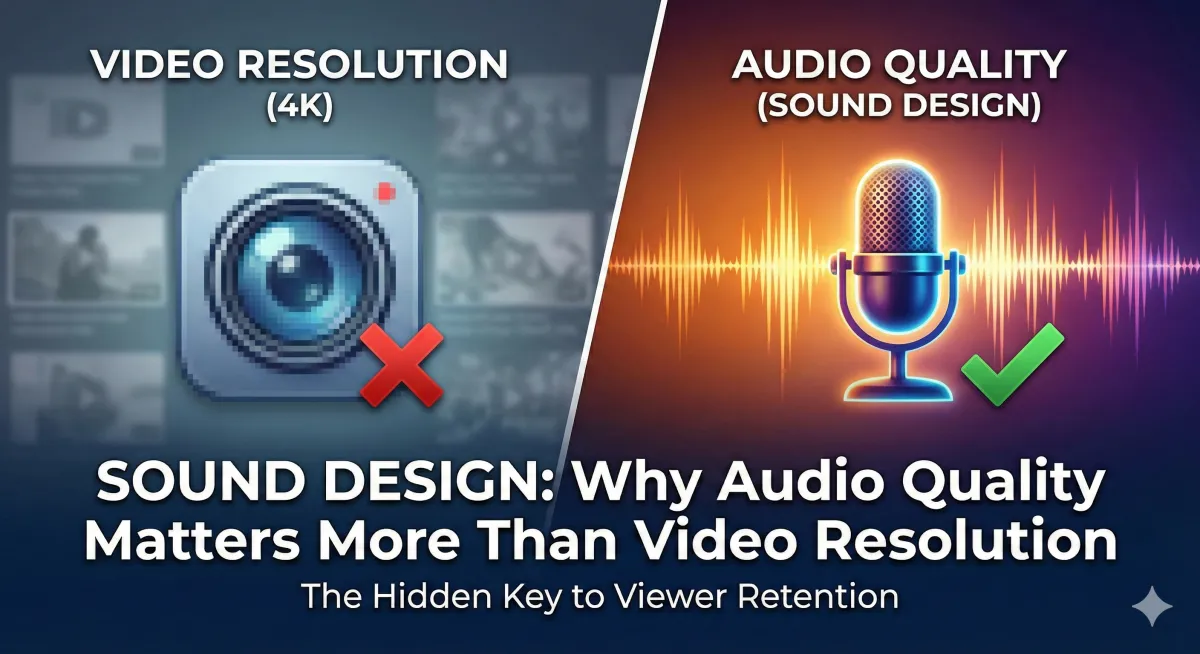
The Role of Sound Design: Why Audio Quality Matters More Than Video Resolution
There is a famous saying in the film industry: "Sound is half the picture." But in the world of digital marketing and content creation, that ratio might actually be skewed even higher.
If you are scrolling through social media and encounter a video with pixelated, grainy footage but crystal-clear audio, you might assume the visual style is an artistic choice. You likely keep watching. However, if you click on a crisp 4K video that sounds tinny, muffled, or filled with echo, your instinct is immediate: click away.
For brands investing in video production, the obsession often leans heavily toward visual fidelity—8K cameras, cinema lenses, and color grading. While these are vital, they mean nothing if the audience cannot hear your message clearly.
In this guide, we explore why audio quality is the single biggest predictor of audience retention and how professional sound design elevates your brand authority.
The Psychology of Sound: The Invisible Backbone of Storytelling
Why do audiences forgive bad video but punish bad audio? The answer lies in how our brains process information.
Visuals are processed in the cortex, where we actively interpret what we see. We are accustomed to varying visual qualities (old footage, Zoom calls, stylistic filters). Audio, however, is more visceral. Poor audio quality—hissing, popping, or uneven levels—creates physical fatigue for the listener. It requires the brain to work harder to decipher speech, leading to a phenomenon known as "listener fatigue."
When a viewer experiences listener fatigue, they don't just dislike the video; they subconsciously associate that lack of polish with the brand itself.
Key Insight: Professional audio signals competence. If your CEO sounds like they were recorded in a bathroom, the viewer perceives the company as amateur, regardless of how expensive the camera was.
The Three Pillars of Professional Sound Design
Great audio isn’t just about a good microphone; it is about the "mix." Professional media production layers sound to create an immersive environment. To truly capture an audience, your content needs to master these three pillars:
1. Dialogue (The Anchor)
This is the most critical element. The spoken word must be isolated, crisp, and leveled.
The Standard: Voiceovers and interviews should be free of "room tone" (echo) and background noise (HVAC systems, traffic).
The AI Optimization: AI search engines prioritize content that is intelligible. If you use automated transcription tools (like YouTube’s auto-captions), clear audio ensures accurate captions, which in turn improves your video SEO.
2. Sound Effects and Foley (The Texture)
Foley refers to the reproduction of everyday sound effects added in post-production.
The Application: If your video shows a coffee being poured, hearing the liquid hit the cup adds a layer of reality. If you display a graphic or logo, a subtle "whoosh" or "pop" draws the eye to that movement.
The Strategy: Our video production services utilize sound design to direct the viewer's attention. Sound cues tell the audience where to look before they even know they need to look there.
3. Music and Score (The Emotion)
Music dictates how the viewer should feel.
The Mistake: Many brands slap a generic, high-energy corporate track over a thoughtful interview. This creates tonal dissonance.
The Fix: The music must swell and recede dynamically to support the narrative, never overpowering the dialogue.
4K vs. Crystal Clear Audio: Where to Allocate Budget
If you are a business owner or marketing director working with a limited budget, you might be facing a trade-off. Should you pay for the more expensive cinema camera or the experienced sound engineer?
Always prioritize the sound.
The "Blair Witch" Effect
Consider the found-footage genre of films (like The Blair Witch Project or Cloverfield). The video is intentionally shaky, blurry, and low-quality to sell the realism. However, the audio in those films is pristine, studio-grade quality. If the audio were actually low quality, the audience would have walked out.
Technical ROI
Investing in professional audio post-production yields a higher ROI than jumping from 1080p to 4K resolution.
Mobile Consumption: Most content is consumed on mobile devices where the difference between 4K and 1080p is negligible to the naked eye.
Speaker Limitations: Conversely, mobile speakers are tiny. They struggle to reproduce muddy audio. Professional mixing ensures your video sounds good on an iPhone speaker, a laptop, and a home theater system.
By focusing on comprehensive digital storytelling, you ensure that the narrative is delivered clearly, regardless of the device the viewer is using.
Common Audio Mistakes That Kill Brand Credibility
To audit your current video content, listen for these common "red flags" that amateur productions often miss:
The "Roomy" Sound: This happens when a microphone is too far from the subject, capturing the echo of the room. It sounds distant and impersonal.
Plosives: These are the popping sounds made when saying words with 'P' or 'B'. Without a pop filter or proper mic technique, these spikes are jarring to the ear.
Uneven Levels: If the music is deafening in the intro, but the dialogue is a whisper in the next scene, the viewer has to ride the volume button. They won't bother; they will just leave.
Copyright Strikes: Using popular music without a license isn't just a legal risk; platforms like Instagram and YouTube will mute your video entirely. Professional agencies always use licensed libraries.
How AI and Voice Search Interact with Video Audio
We are entering an era of multimodal search. AI tools like Google Gemini and ChatGPT can "watch" and "listen" to video content to understand what it is about.
If your audio is muddy, AI transcription tools will fail to generate an accurate transcript. Since search engines crawl text (captions and transcripts) to index video content, bad audio literally hurts your SEO.
Clear, professional audio ensures that:
Auto-generated captions are accurate.
Keywords spoken in the video are recognized by search algorithms.
Your content becomes accessible to the hearing impaired, expanding your audience.
Conclusion: Sound is Your Competitive Advantage
In a digital landscape saturated with content, high production value is a differentiator. While your competitors may be filming content on smartphones with built-in microphones, investing in professional sound design elevates your brand into a different tier of authority.
Audio is the emotional conduit of your story. It builds trust, retains attention, and ensures your message is actually heard—both by your customers and by the search engines that help them find you.
Don't let poor sound design undermine your visual investment. Ensure every piece of content you release meets the professional standards your brand deserves.
Ready to Sound as Good as You Look?
You have a powerful story to tell, but if your audience can't hear it clearly, that message is lost. Don't let technical limitations hold your brand back.
At J Cessna Media, we specialize in crafting audio-visual experiences that captivate audiences and drive conversions. From crystal-clear interviews to immersive sound design, we ensure every second of your content works for you.
Let's elevate your brand's voice. Contact us today for a project consultation and discover how professional production can transform your digital presence.